
UD / JOURNAL
Curve Appeal
How a hand-troweled plaster stair at our most recent design project uses history, geometry, and craft to shape movement and mood.
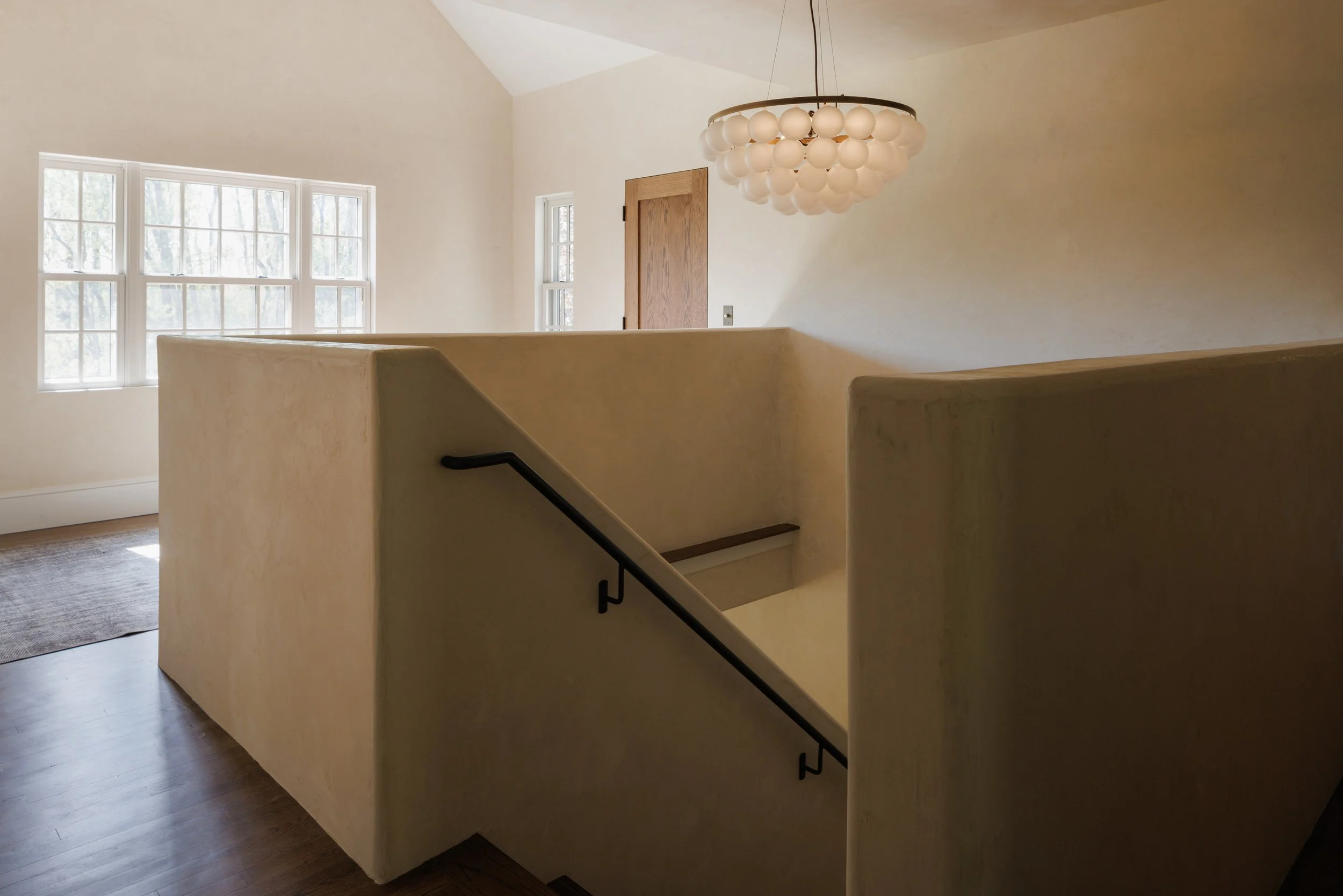
Mill House is a study in restraint, where form, material, and craft do the heavy lifting. The plaster curved staircase sits at the center of that philosophy. Rather than treating the stair as a purely functional connector, we approached it as an architectural moment. Sculptural, tactile, and quietly grounding. Its soft curves guide movement through the house and set the emotional tone for the spaces beyond.
To understand why plaster was the right choice here, it helps to be clear about what plaster actually is. At its simplest, plaster is a paste made from a binder, typically lime or gypsum, mixed with water and often an aggregate such as sand, then applied wet and allowed to harden into a durable surface. Those binders behave very differently. Gypsum plaster sets through a chemical reaction that forms interlocking crystals as it hardens, creating strength quickly. Lime plaster cures more slowly, absorbing carbon dioxide from the air and gradually turning back into limestone. Both systems reward patience, skill, and a deep understanding of timing.
Plastering is one of the oldest building techniques in human history, used for thousands of years across cultures. It has endured not only because it is durable, but because it is repairable, breathable in many formulations, and uniquely responsive to the hand. Unlike drywall or panelized systems, plaster records the process of its making. Subtle variations, trowel marks, and depth are not flaws. They are the material’s language. At Mill House, plaster allowed us to create something that feels both ancient and modern, solid yet soft.
Curved plaster forms have a long architectural lineage. In traditional Moroccan tadelakt, lime plaster is compacted and polished to create seamless, water-resistant surfaces that naturally lend themselves to curves and rounded transitions. In modern architecture, curved walls became a way to choreograph movement and emotion rather than simply divide space. Architects like Le Corbusier used curved forms to slow circulation, shape light, and create moments of enclosure and release. That history informed our approach at Mill House. The curve is not decorative. It is structural to the experience of moving through the home.
Designing the Mill House staircase began with geometry and discipline. A successful curve cannot be improvised in the field. The radius, height, and proportions must be resolved early, along with how the curve meets floors, ceilings, and adjacent walls. We conceived the stair enclosure as a single mass, as though it were carved out rather than assembled. That decision required close coordination between framing, stair construction, and substrate so the plaster could read as continuous and intentional.
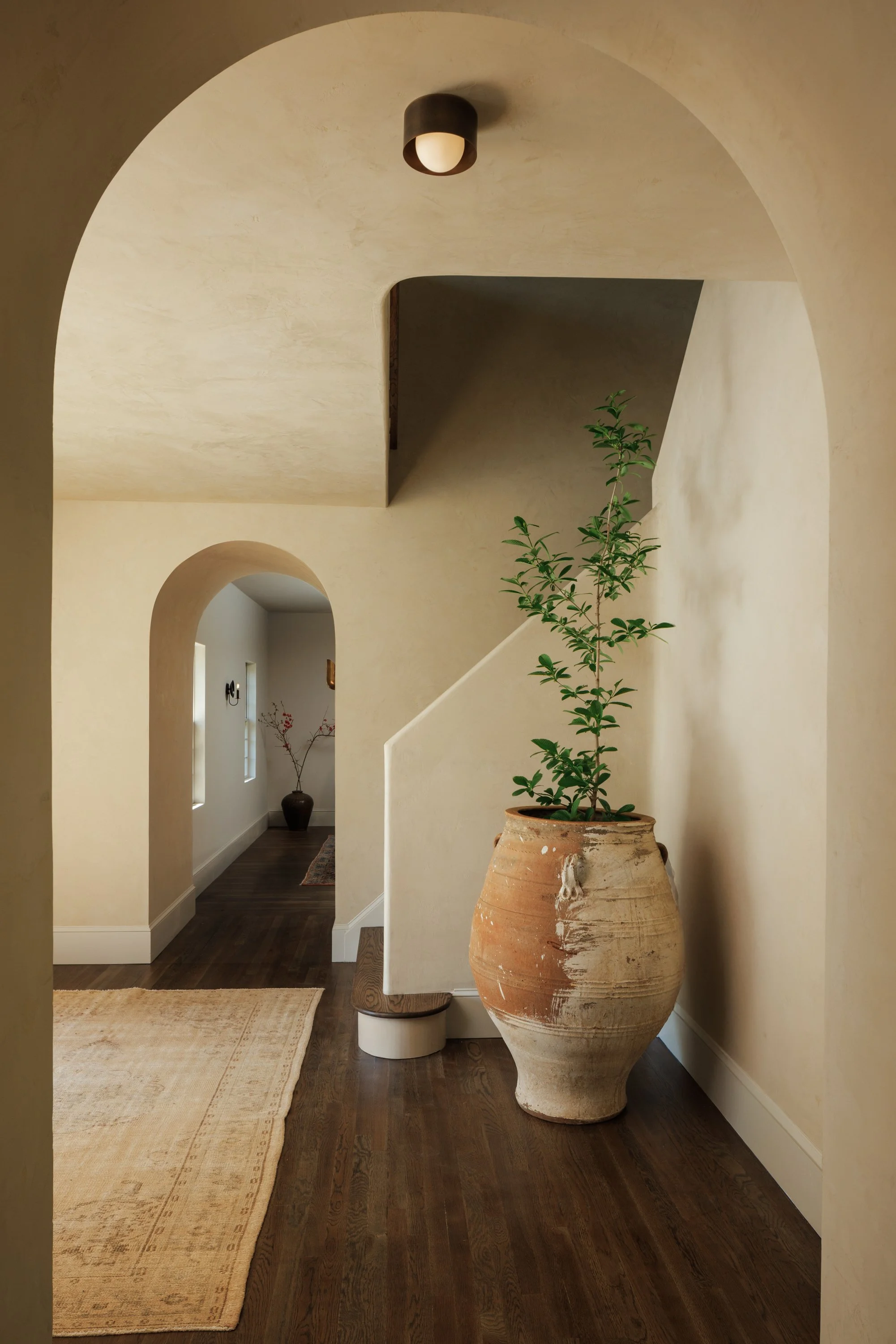
Execution is where plaster either becomes timeless or feels unfinished. Traditional plaster systems are built in layers, beginning with structural base coats that establish strength and plane, followed by a finish coat that delivers the final surface. Curves amplify the importance of this process. Every pass of the trowel shapes how light moves across the wall. Timing, moisture, temperature, and pressure all matter, especially on continuous surfaces where seams and inconsistencies have nowhere to hide.
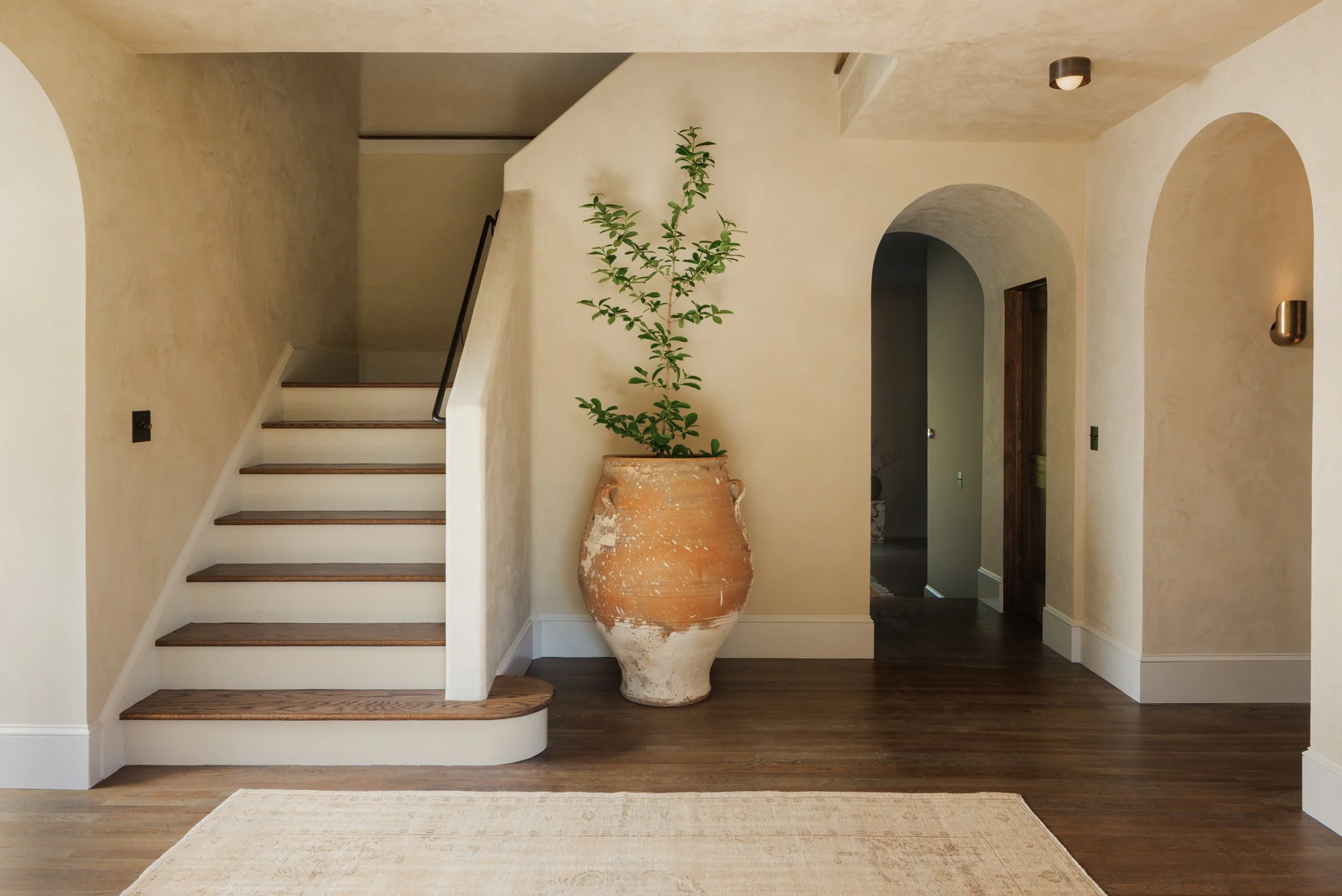
At Mill House, the craft lives in the transitions. The curve remains true as it meets landings and returns, with edges softened rather than trimmed. The finish is burnished just enough to create depth without shine, allowing light to graze the surface instead of reflecting off it. A darkened steel handrail floats lightly against the plaster, offering contrast and clarity without competing with the form. The goal was continuity. One material, one volume, one experience.
At Upstate Down, we are drawn to materials that age well and spaces that feel inevitable, as though they could only exist in one way. The plaster curved staircase at Mill House embodies that belief. Rooted in centuries-old material knowledge and executed through careful coordination and handwork, it is more than a stair. It is architecture shaped by time, touch, and restraint.
Sources
Encyclopaedia Britannica, Plaster
https://www.britannica.com/technology/plaster-building-materialBuilding Conservation Directory, Lime Plaster and Traditional Finishes
https://www.buildingconservation.com/articles/limeplaster/limeplaster.htmVictoria and Albert Museum, Plaster and Decorative Finishes
https://www.vam.ac.uk/articles/plasterArchDaily, Tadelakt: The Ancient Moroccan Plaster Technique
https://www.archdaily.com/896099/tadelakt-the-ancient-moroccan-plaster-techniqueFondation Le Corbusier, Ronchamp and Curved Architectural Form
https://www.fondationlecorbusier.fr